
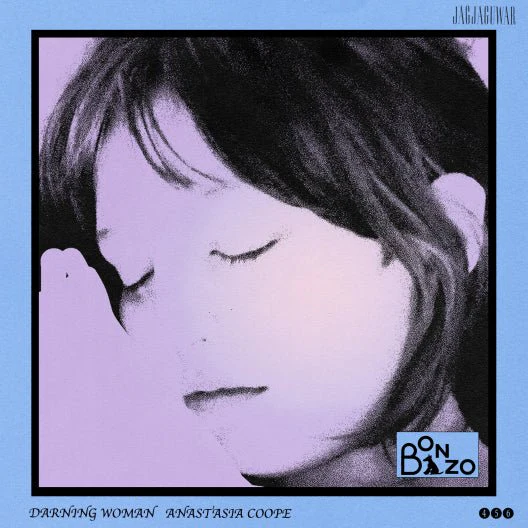
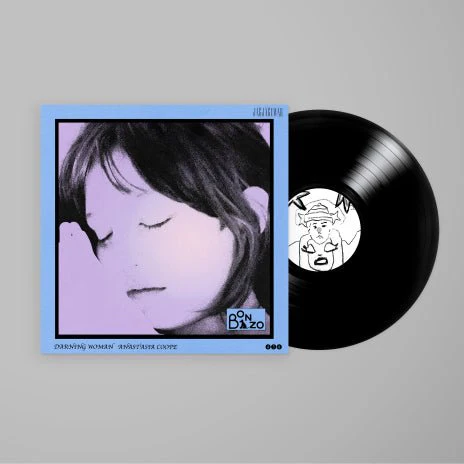
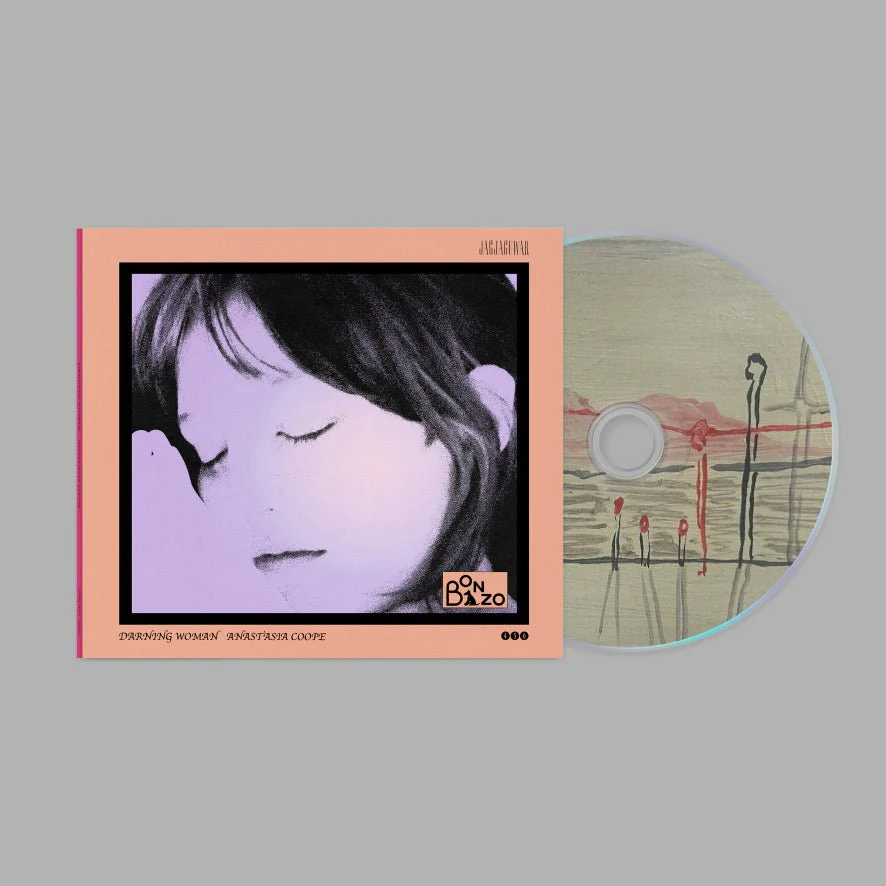
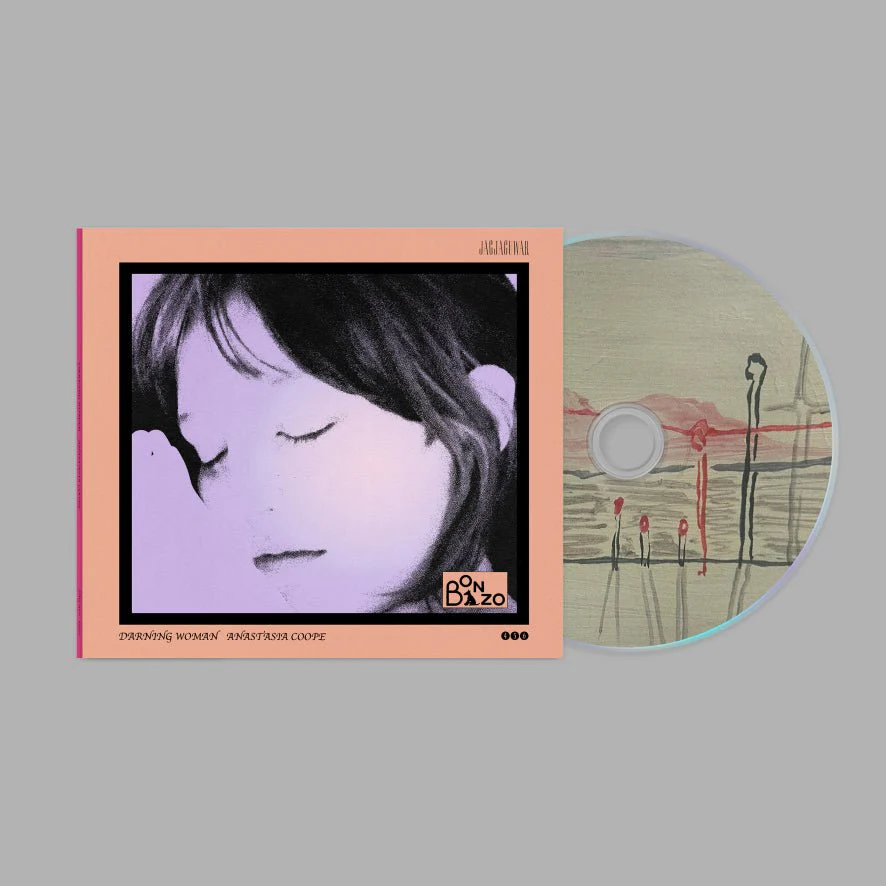
Darning Woman
The feeling that Anastasia Coope's music transmits seems to emanate from a precipice beyond the material world, like a void or memory pressing up against the veil. It’s exacting and enveloping, but unmoored in space and time: ghostly, spectral, far-out folk. Darning Woman, her debut album, feels like a dispatch from another past. Akin to lullabies or nursery rhymes, its minimal folk instrumentation contorts into something staccato and strange led by Coope's expressive, stratified vocals.
In spite of the suggestion of antiquity that runs through Darning Woman, 21-year-old, Brooklyn-based Coope is very much a contemporary artist. Born to an English father and American mother (whose original Martin acoustic she uses to compose), she was raised in the New York village of Cold Spring. The lonely landscapes and small towns of the Hudson Valley populate her songwriting, setting wintry backdrops against the acrobatics of her voice. Her experience making this record was a largely insular one, too; she began recording music while staying at a relative’s empty home in Beacon, NY, experimenting with recording software in an empty living room, singing directly into the open space. Until that point, Coope had only thought of herself as a visual artist, not a musician– but it felt right immediately. Throughout the next year, she worked to invent the lush, sweeping universe conveyed here.
Her voice is the core of this work - emotive, oscillating between shadowy effervescence and something more guttural, building atop itself. Coope spent months teaching herself to sing in a new way, through hocketing and layering her voice, constructing choirs of herself. These songs often start from a chorus or phrase that gets stuck in Coope’s head and bloom into chaotic, fractured earworms. There’s a slew of past cultural touchstones that inform her approach to music making – the avant-garde art rock of the ‘80s; Trish Keenan or Su Tissue or Brigitte Fontaine; medieval choruses; church choirs; contemporary folk; romantic close harmonies groups of the ‘50s; Meara O'Reilly’s Hockets for Two Voices. But rather than the sonics of those works, Coope was instead moved by the ephemera surrounding them, their songs’ abilities to conjure whole worlds.
Here, the lush, romantic opener “He Is On His Way Home, We Don’t Live Together” is the portal into Coope’s universe. It teeters in, disquieted, a choral slowburn building into something between hysteria and euphoria, with a slinking piano and a jarring electric guitar line closing out the din. On later songs, like “Sounds of a Giddy Woman,” the auditory illusions became tactile as she composed: “I was able to envision a room of things happening, rather than me just building something,” Coope says. “The record was me starting to think spatially about music.”
Coope’s songwriting revolves around intuition and aesthetics, rather than precise lyrical storytelling; she has a striking ability to invoke a sense of movement with her makeshift mantras. The word “woman” appears repeatedly throughout the album’s song titles, but for Coope, that was an unconscious motif. “The word ‘woman’ was having a physical idea of what my songs were trying to represent through this idea of a muse or an idol or an icon,” she says. “It was a mix of the idea of being maternal, of housekeeping, and then also the idea of a character, a star.”
The title track serves as a skeleton key for the entire record; “Darning Woman” is a hyperphysical sing-song, a literal instruction to darn and repair, the wane and waxing repetitions that make up a life. It’s the umbrella under which the rest of the songs live. Decisive in its fervor, it loops around nesting: mending, cleaning, housework – collecting, building, and decorating – the hands-on, tangible aspects of at-home life.
These songs are built from that, and mantras plucked from the ether or poems and fragments of overheard conversations jotted down, transformed into an entity unknown. Like Coope’s paintings, drawings, and mixed media artworks, which occasionally feature among the imagery in her album and single materials, her songwriting yields an esoteric distance. It’s the feeling of the work pushing back on you, holding you at arms’ length. It invites you to see, to feel, rather than know – but for all that’s arcane here, Darning Woman is rooted deeply in the things we can touch. --Libby Webster
Original: $14.99
-65%$14.99
$5.25Product Information
Product Information
Shipping & Returns
Shipping & Returns
Description
The feeling that Anastasia Coope's music transmits seems to emanate from a precipice beyond the material world, like a void or memory pressing up against the veil. It’s exacting and enveloping, but unmoored in space and time: ghostly, spectral, far-out folk. Darning Woman, her debut album, feels like a dispatch from another past. Akin to lullabies or nursery rhymes, its minimal folk instrumentation contorts into something staccato and strange led by Coope's expressive, stratified vocals.
In spite of the suggestion of antiquity that runs through Darning Woman, 21-year-old, Brooklyn-based Coope is very much a contemporary artist. Born to an English father and American mother (whose original Martin acoustic she uses to compose), she was raised in the New York village of Cold Spring. The lonely landscapes and small towns of the Hudson Valley populate her songwriting, setting wintry backdrops against the acrobatics of her voice. Her experience making this record was a largely insular one, too; she began recording music while staying at a relative’s empty home in Beacon, NY, experimenting with recording software in an empty living room, singing directly into the open space. Until that point, Coope had only thought of herself as a visual artist, not a musician– but it felt right immediately. Throughout the next year, she worked to invent the lush, sweeping universe conveyed here.
Her voice is the core of this work - emotive, oscillating between shadowy effervescence and something more guttural, building atop itself. Coope spent months teaching herself to sing in a new way, through hocketing and layering her voice, constructing choirs of herself. These songs often start from a chorus or phrase that gets stuck in Coope’s head and bloom into chaotic, fractured earworms. There’s a slew of past cultural touchstones that inform her approach to music making – the avant-garde art rock of the ‘80s; Trish Keenan or Su Tissue or Brigitte Fontaine; medieval choruses; church choirs; contemporary folk; romantic close harmonies groups of the ‘50s; Meara O'Reilly’s Hockets for Two Voices. But rather than the sonics of those works, Coope was instead moved by the ephemera surrounding them, their songs’ abilities to conjure whole worlds.
Here, the lush, romantic opener “He Is On His Way Home, We Don’t Live Together” is the portal into Coope’s universe. It teeters in, disquieted, a choral slowburn building into something between hysteria and euphoria, with a slinking piano and a jarring electric guitar line closing out the din. On later songs, like “Sounds of a Giddy Woman,” the auditory illusions became tactile as she composed: “I was able to envision a room of things happening, rather than me just building something,” Coope says. “The record was me starting to think spatially about music.”
Coope’s songwriting revolves around intuition and aesthetics, rather than precise lyrical storytelling; she has a striking ability to invoke a sense of movement with her makeshift mantras. The word “woman” appears repeatedly throughout the album’s song titles, but for Coope, that was an unconscious motif. “The word ‘woman’ was having a physical idea of what my songs were trying to represent through this idea of a muse or an idol or an icon,” she says. “It was a mix of the idea of being maternal, of housekeeping, and then also the idea of a character, a star.”
The title track serves as a skeleton key for the entire record; “Darning Woman” is a hyperphysical sing-song, a literal instruction to darn and repair, the wane and waxing repetitions that make up a life. It’s the umbrella under which the rest of the songs live. Decisive in its fervor, it loops around nesting: mending, cleaning, housework – collecting, building, and decorating – the hands-on, tangible aspects of at-home life.
These songs are built from that, and mantras plucked from the ether or poems and fragments of overheard conversations jotted down, transformed into an entity unknown. Like Coope’s paintings, drawings, and mixed media artworks, which occasionally feature among the imagery in her album and single materials, her songwriting yields an esoteric distance. It’s the feeling of the work pushing back on you, holding you at arms’ length. It invites you to see, to feel, rather than know – but for all that’s arcane here, Darning Woman is rooted deeply in the things we can touch. --Libby Webster